AI-Powered M&A Due Diligence
Close diligence in 3 days instead of 3 weeks. Win more mandates by undercutting the pitch that still runs on Intralinks.
Institutional-grade AI analysis for PE firms and M&A advisors.
Surface contract risks across entire portfolios before closing.
Self-hosted. Your data never leaves your network. Enterprise AI at small-firm prices.
The 3-day timeline is a function of deal complexity, not document count. Document thresholds are current optimal targets on today's Apple Silicon, not hard limits. BD can confidently say yes to 2,500-doc deals and talk honestly about where the envelope extends.
Sweet Spot
Single-jurisdiction, single-asset acquisition. Standard M&A document stack. Doc count is typically 1,000 to 5,000 on today's hardware. 3-day turnaround is the engineered floor for this profile.
Extended Envelope
Multi-asset or multi-jurisdiction deals with localized regulatory review and non-standard IP. Current optimal target 5,000 to 10,000 documents. Timeline extends to 4-5 days. Still dramatically faster than the 3-week cloud baseline.
Walk-Away
Consortium-structured mega-deals with dozens of jurisdictions and 50-plus concurrent advisors on a shared room. Honest answer today: DATAROOM is not the right tool for this complexity tier. We say so up front.
Document thresholds reflect current Apple Silicon capacity. Next-generation hardware will extend these envelopes. We publish them so BD can pitch with numbers, not hope.
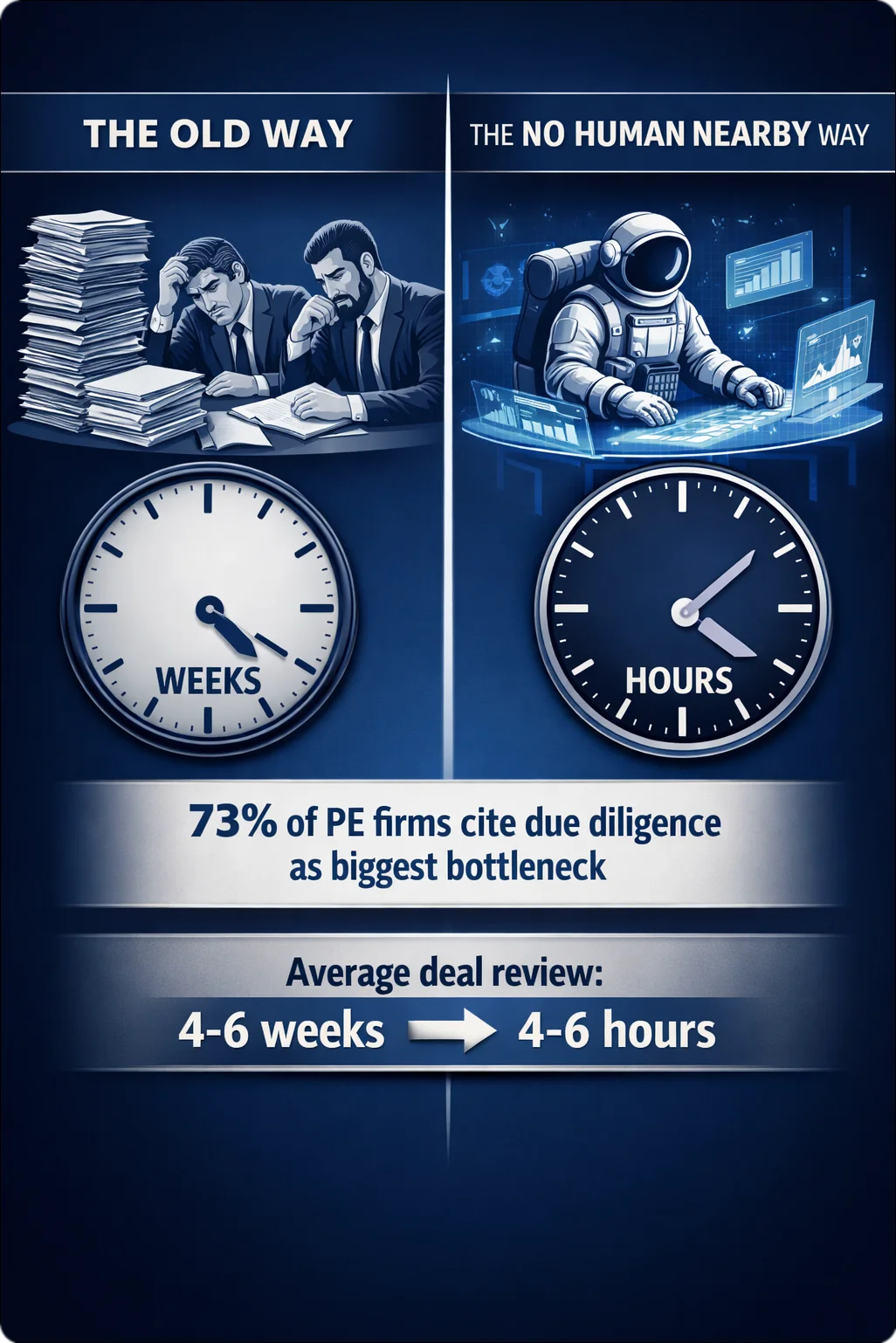
73% of PE firms cite due diligence as their biggest deal bottleneck. Here's why.
1,000+ contracts per acquisition. Junior associates drowning in documents while senior partners wait for answers that should take hours, not weeks.
Change of control clauses buried on page 47. Customer contracts with assignment restrictions. The risks that kill deals after LOI.
Different analysts flag different issues. Without standardized playbooks, you're gambling that nothing slips through the cracks.
PE-grade due diligence, delivered in hours.
Upload entire data rooms. Our AI processes 1,000+ contracts in parallel, flagging change of control, assignment, and termination risks.
Pre-built playbooks for Change of Control, Customer Risk, IP Review, Employment, and MAC clauses. Your firm's standards, automated.
Executive summaries for IC. Detailed findings for legal. Everything your deal team needs to make the call.
Every DATAROOM analysis hunts for these. Click any row for the plain-English explanation your analysts will appreciate and your partners will actually read.
Permits a counterparty to terminate, renegotiate, or accelerate obligations when ownership of the target company changes. Typical in customer contracts, supplier agreements, and licensing deals.
A buried change-of-control clause in the target's top-5 customer contract can evaporate 20% of post-close revenue. DATAROOM flags every one during diligence, before the LOI gets signed.
Prohibits the transfer of a contract to a new owner without the counterparty's consent. May require written approval, impose fees, or allow outright termination.
If your target's material contracts are non-assignable, the deal structure (asset vs. stock) changes and your consent-gathering timeline explodes. DATAROOM surfaces the full list on day one of diligence.
Requires one party to fully compensate the other for losses without a cap on dollar exposure. Often tied to IP infringement, data breach, or regulatory violations.
Uncapped IP indemnities have cost acquirers nine-figure settlements years after close. DATAROOM tags every indemnity by category, cap status, and survival period so your deal lawyers can model real exposure.
Material Adverse Change / Effect language allows a party to walk from the deal (or renegotiate) if a defined bad thing happens between signing and closing. Wording here is everything.
The difference between "material and adverse" and "would reasonably be expected to result in a material adverse effect" is billions of dollars of litigation. DATAROOM extracts the exact MAC language from every target agreement so deal counsel can benchmark it fast.
Identifies contracts representing disproportionate revenue and surfaces any non-compete, exclusivity, or most-favored-nation terms that restrict the combined entity's go-to-market.
A customer contributing 18% of revenue with an exclusivity clause tied to "existing geographies" can freeze your entire expansion thesis. DATAROOM cross-references the customer ledger with contract terms automatically.
Scans contractor, employment, and advisor agreements for missing or defective IP assignment language. Flags open-source license obligations, joint-development carve-outs, and moral rights waivers.
A single senior contractor who never signed an IP assignment can cloud title on the target's core product. DATAROOM catalogs every contributor agreement so your diligence team knows exactly what the target owns before closing.
We hear this question a lot. Here's why browser AI is a liability waiting to happen.
Browser AI sends your client's contracts to third-party servers. Every NDA, every M&A document, every settlement agreement - sitting on someone else's cloud.
When opposing counsel asks in discovery "Did you share privileged documents with third parties?" - what's your answer?
Our system keeps data on YOUR infrastructure. That's privilege protection.
Browser AI chat history disappears. When the bar or a client asks what AI reviewed their documents and what decisions were made - do you have receipts?
ABA Formal Opinion 512 requires you to understand where client data goes and maintain oversight of AI tools.
We log every action, every AI output, every human decision with timestamps. Full compliance documentation.
Browser AI gives answers. When the AI misses something and you get sanctioned, whose fault is it? You can't blame ChatGPT in court.
Those "AI does it all" tools are selling you liability. We're selling you protection.
AI flags, humans decide. Every finding is verified before delivery. That's what ABA 512 actually requires.
Source: LawGeex AI Contract Review Study
When you send contracts for "AI analysis," do you know what's actually reviewing them?
Industry reports have revealed that some legal AI companies use humans to perform work advertised as AI-powered. Employees have publicly described reviewing contracts that clients believed were AI-processed.
We built NO HUMAN NEARBY differently.
Genuine AI analysis, not humans pretending. No black boxes. No surprises.
Your documents are processed on our infrastructure. No OpenAI. No Azure. No third-party cloud.
No humans reading your privileged documents behind the scenes. When we say AI, we mean AI.
100% AI. 0% Humans Behind the Curtain.
Send your contract via secure portal
28+ formats supported
AI scans for 50+ risk factors in under 5 minutes
Human expert verifies findings and flags priorities
Receive executive PDF report within 24 hours
Both incumbents are storage products with compliance layers. DATAROOM is a sovereign AI analyst. Here's the feature-by-feature read.
| Capability | DATAROOM | Intralinks | Firmex |
|---|---|---|---|
| Local AI contract analysis | ✓ | ✕ | ✕ |
| MNPI never leaves firm infrastructure | ✓ | ✕ cloud-hosted | ✕ cloud-hosted |
| Zero third-party AI inference calls | ✓ | partner AI add-ons | partner AI add-ons |
| Automated deal-killer clause extraction | ✓ 50+ categories | ✕ | ✕ |
| Bulk contract parsing (1,000+ documents) | ✓ parallel | manual tagging | manual tagging |
| Virtual data room file hosting | ✓ | ✓ | ✓ |
| Granular user permissioning & audit log | ✓ | ✓ | ✓ |
| Q&A workflow | ✓ AI-assisted | ✓ | ✓ |
| Deal team pricing model | ✓ flat monthly | per-page | per-page |
| Founder license / equity stake available | ✓ | ✕ | ✕ |
The incumbents solved document hosting fifteen years ago. DATAROOM solves what's actually in the documents - the layer your associates bill four hundred dollars an hour to read through.
Competitor capabilities based on publicly available product documentation as of April 2026. Feature parity changes regularly; confirm current offerings with each vendor.
Associates care about the 3 days vs 3 weeks. Senior partners care about one thing: what happens when the firm gets breached. The honest answer matters.
"True data sovereignty is mathematically superior to a legal contract saying we will pay you if we get hacked."
An indemnification clause is a promise. Local inference on a firm-owned appliance is a physical fact. One survives a lawsuit. The other survives a breach. A senior partner evaluating risk does the math without having to be told what to conclude.
Contractual Remedy
Documents sit on a third-party cloud. A breach happens. The firm sues the vendor under an indemnification cap. Months of litigation, reputational damage, client defections.
The lawsuit might win. The damage is already done.
Mathematical Impossibility
Documents never leave the firm. The third-party cloud breach fact pattern cannot arise because there is no third-party cloud in the diligence workflow.
The vault in your basement does not evaporate.
AI is noise cancellation. The lawyer reads only the things that matter. The shield is the architecture. The speed is the bonus.
Most PE deals stall on one question: "Is this vendor cleared by our IT team?" We pre-filled the paperwork so yours is a short meeting.
A pre-completed security questionnaire, architecture overview, data-flow diagram, and FAQ covering every question a CISO has ever asked us. Hand it to your IT team, clear vendor review in one pass.
Lock in founder pricing before regular subscriptions go live.
Once they're gone, it's full price. Lock in your rate before the next tier fills.